Fonds Prévention Argile: a government scheme to protect homes from cracks, from eligibility check to application 🏠
beta.gouv
Public service
DSFR
User research
Designing the journey for a government grant that protects homes from cracks caused by clay shrink-swell, with two tools that don't talk to each other.
Client
French Ministry for Ecological Transition (DGALN) × beta.gouv (DINUM)
Designing the end-to-end journey for a new government grant, from the eligibility simulator to payment for the works, while connecting two tools that don't talk to each other.
📈 What I brought
A dashboard that acts as the common thread between the website and Démarche Numérique, two simulators, an advisor workspace, and a survey of ~800 inactive applicants (316 responses) that led to new information blocks and automated emails.
🔧 What I could have done better
I should have set up automated user surveys sooner. I focused on qualitative research, and it wasn't enough.
💡 What I learned
Designing for a public service means a non-financial goal, a government design system to follow, and accessibility at the heart of every decision.
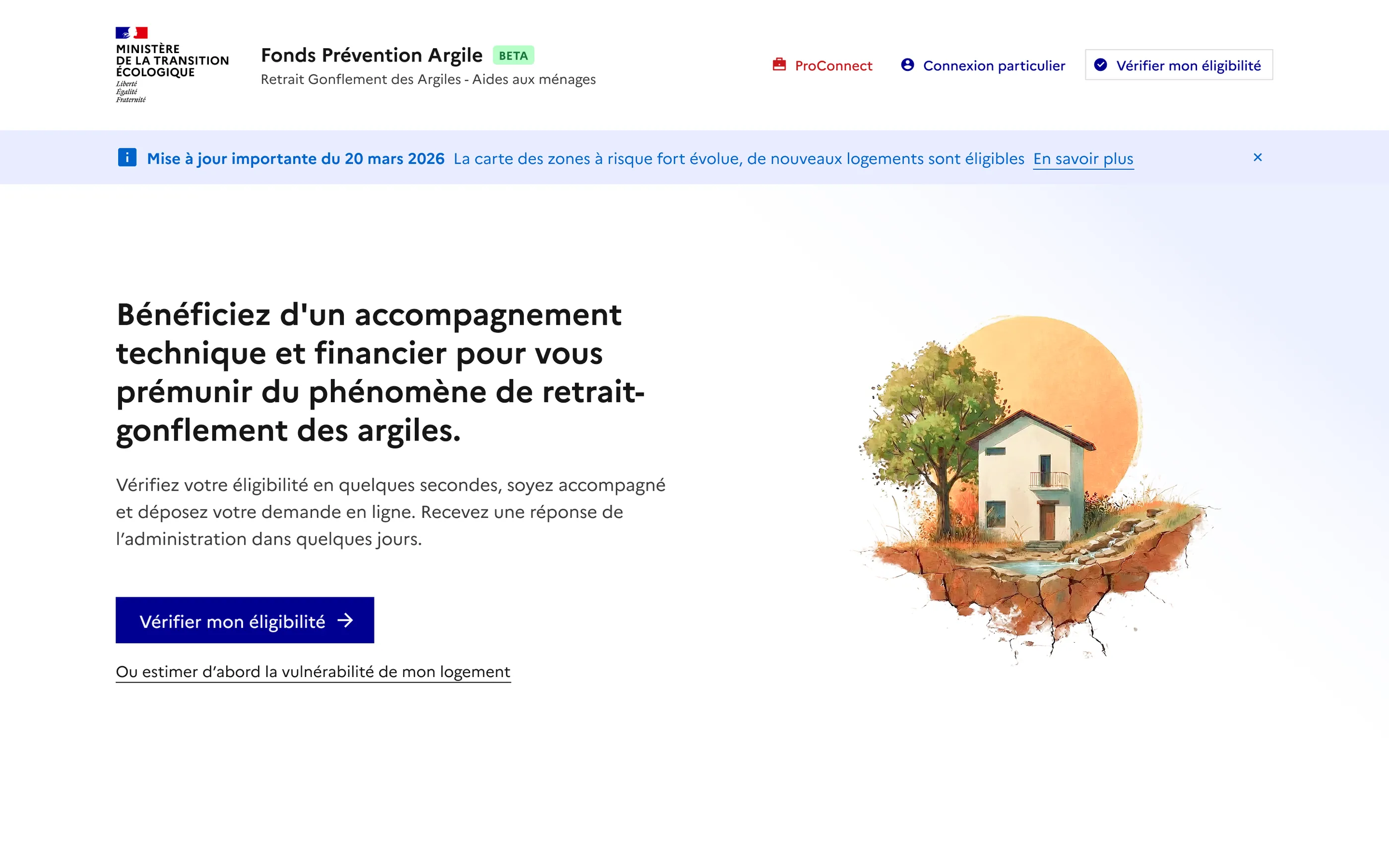
The home page: check your eligibility, or first assess how vulnerable your home is.
Clay shrink-swell is what happens when clay soil shrinks in dry weather and swells when it rains. Year after year, this movement weakens foundations: cracks, sticking doors, partition walls pulling away, broken pipes.
It's the second most costly natural hazard in France after flooding. Rather than paying out compensation after the fact, the French government is piloting a prevention fund: it pays for a home assessment, then for simple works (rainwater management, vegetation too close to the house, waterproofing around the foundations) before the damage happens.
My role: design the journey that takes a homeowner from “does this apply to me?” all the way to payment for the works, in line with the French State Design System (DSFR).
The mission in numbers 📊
2ndmost costly natural hazard in France, after flooding
11pilot departments for the trial
5steps, from the eligibility check to payment for the works
5stakeholder profiles: homeowners, Aller Vers advisors, AMOs, project managers and DDTs
Two tools that don't talk to each other 🧩
The whole project hinges on one constraint. The journey relies on two building blocks: the scheme's website, with its simulator, and Démarche Numérique, the government platform used to submit documents and have applications reviewed by the DDTs (local state services).
The problem: Démarche Numérique can't chain several procedures together. Yet applicants submit several in a row: support, eligibility, assessment, quotes, then works and payment. Left as is, they'd end up with several forms with no obvious link between them, and no idea where they stand.
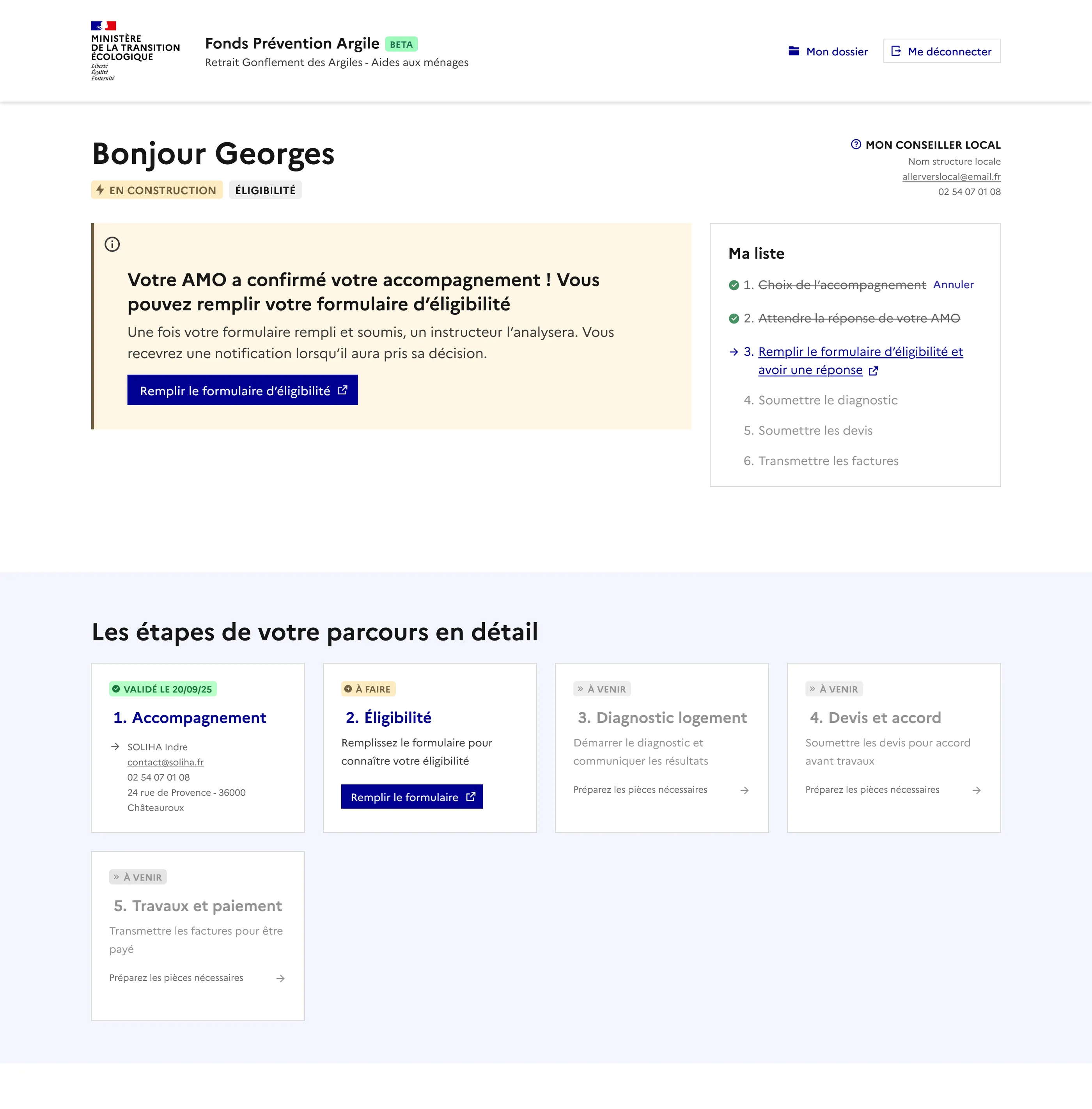
The approach: make the website the common thread. After the simulator, applicants log in with FranceConnect and land on a dashboard that tells them which step they're at and what's expected of them, and sends them to the right form at the right time. Every step follows the same pattern: I submit my documents, the DDT reviews them, and I either move on to the next step or get asked to make corrections.
The applicant dashboard: where they stand, what they need to do now, and a breakdown of the 5 steps of the journey.
Know right away whether it applies to you 🧮
There are many criteria: detached single-family home, primary residence, high-exposure zone, built at least 15 years ago, insured, no ongoing natural disaster (CatNat) claim, Anah income ceilings… You can't ask anyone to read all that before getting started.
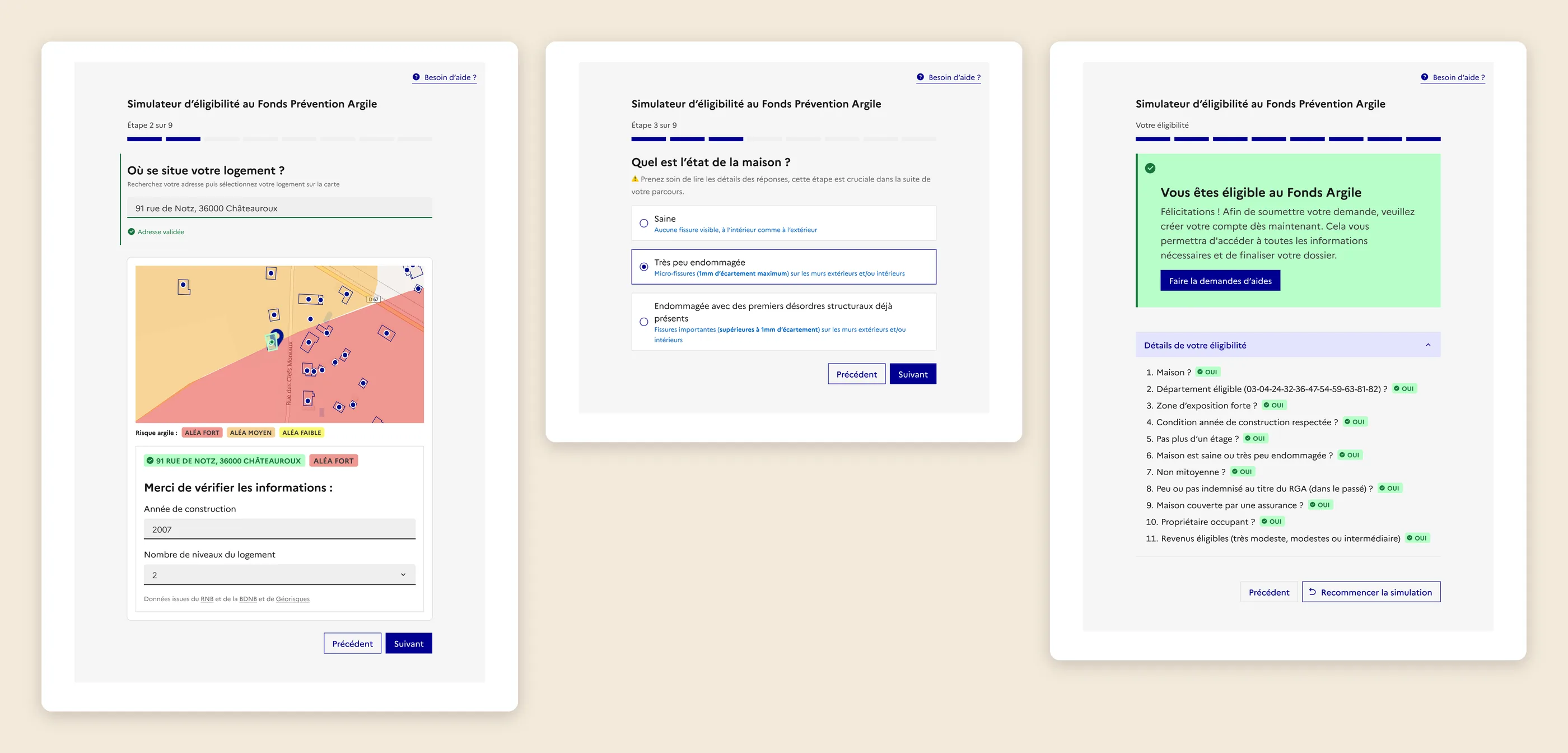
The eligibility simulator asks these questions one at a time (location on a map, condition of the house, household situation, taxable income) and gives a clear result. If someone isn't eligible, they know before filling out a single form.
Beyond designing the funnel steps, I also worked on its evolution, with the constant goal of improving conversion (the government has its own Matomo instance: not pretty, but it does the job).
Three steps of the eligibility simulator: locating your home on the risk map, describing its condition, then getting a detailed, criterion-by-criterion result.
Understanding your home before taking the plunge 🔍
Many homeowners don't know their cracks have a name, or that they can be prevented. A second tool, the vulnerability simulator, helps them understand what's wrong with their home, so they can take the first step.
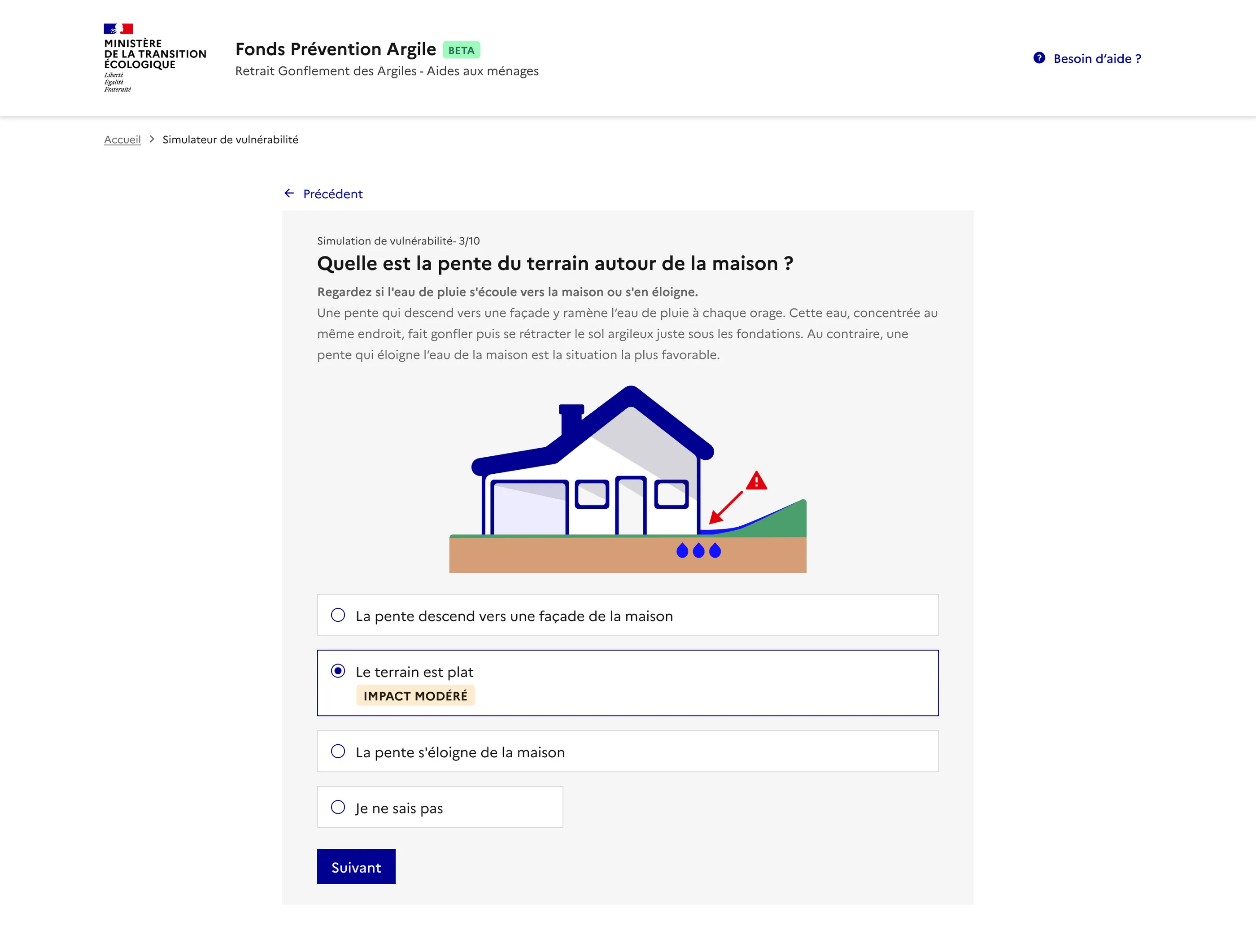
I designed the funnel as well as the illustrations that bring context to a fairly technical subject for the average person.
A question from the vulnerability simulator, illustrated so anyone can answer without technical knowledge.
Equipping the people who provide support 🤝
An applicant is never alone: an “Aller Vers” advisor points them in the right direction, an AMO (project support provider) helps with the paperwork, a project manager oversees the works, and the DDT reviews each step. And the process varies from one department to another.
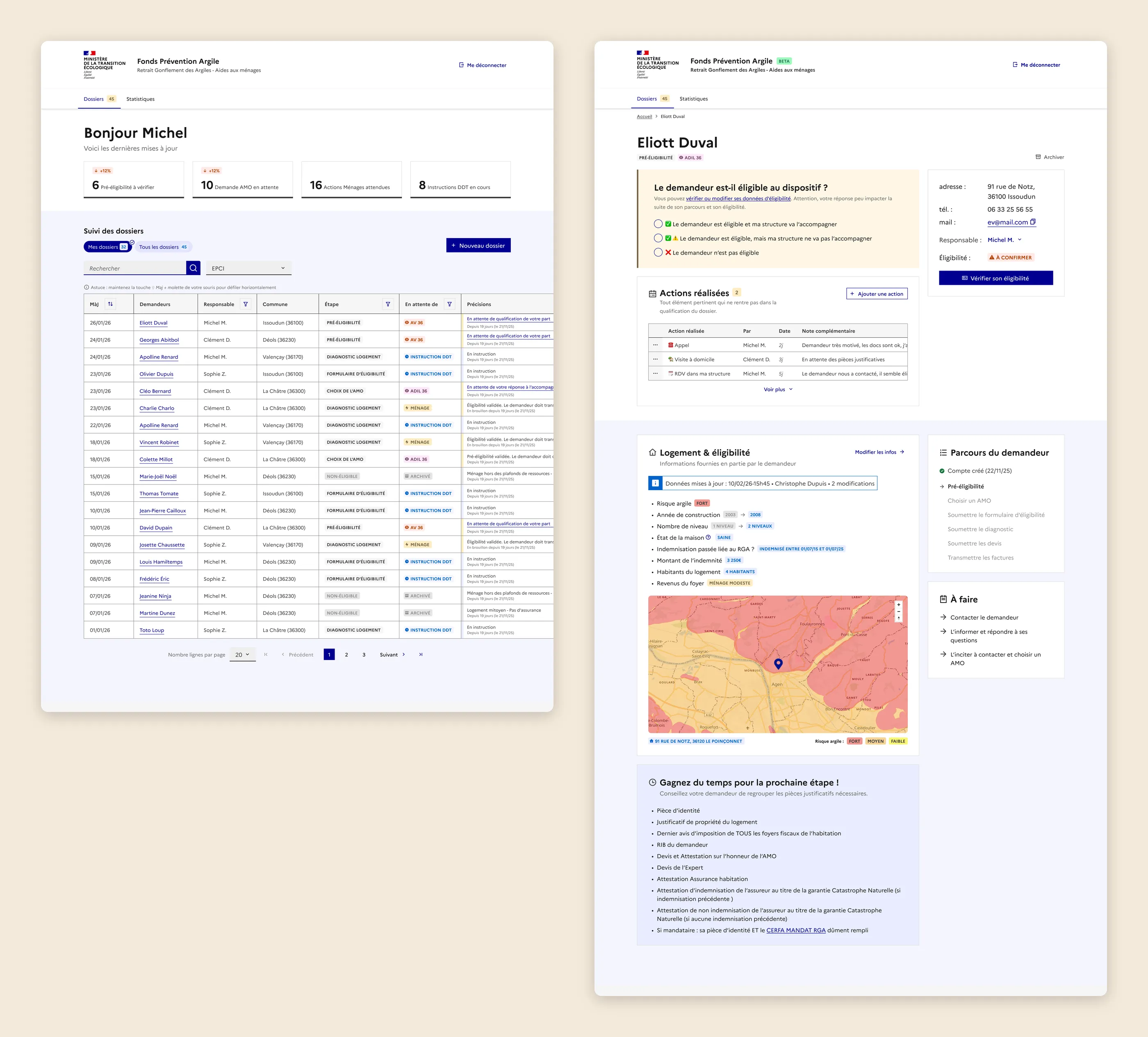
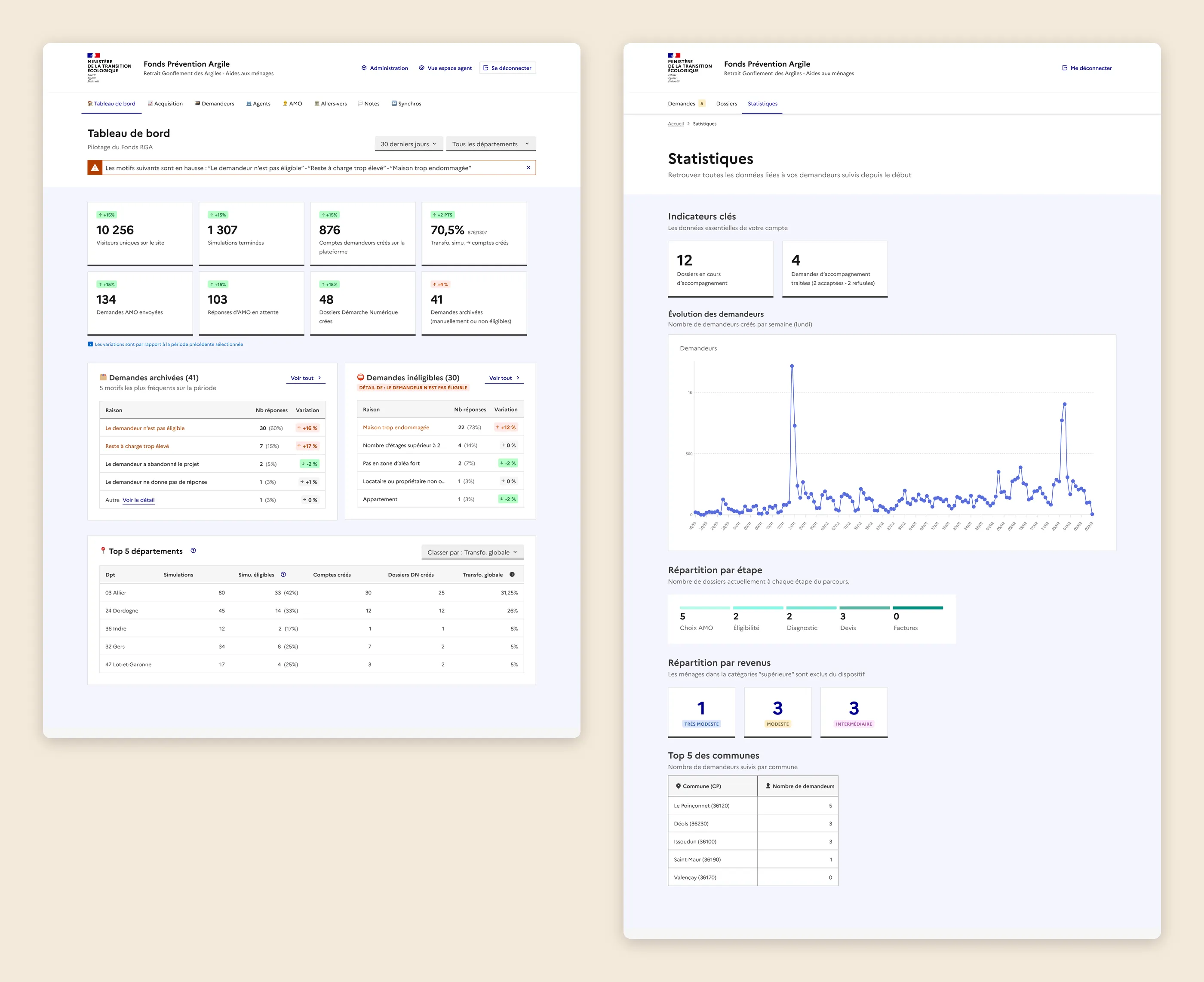
These advisors have their own workspace: their list of applications, the status of each one, statistics for their department and, above all, the next action needed to unblock an applicant.
Quite the challenge: the content and information are extremely dense, and at the time, the French State Design System didn't have enough components to meet the needs. So I had to extrapolate on my own while staying within the guidelines (especially regarding accessibility).
Left: an advisor's application tracking. Right: an applicant's file, with eligibility assessment, action history, journey and next steps.For oversight: the admin dashboard (reasons for dropping out and ineligibility, top departments) and an advisor's statistics.
Reaching out to those who drop off 📬
The numbers showed applications stalling at the early steps, without telling us why. Rather than guess, we asked.
In July 2026, an email went out to every applicant who had been inactive for more than two weeks at the eligibility or assessment step, with a short form: “Where are you at?”. Each free-text answer was then read and categorized one by one, and cross-checked against the boxes ticked. A reason was only kept if the person clearly presented it as what was holding them back.
~800applicants contacted
316responses analyzed, about 4 in 10 people
Where do respondents stand?
Moving forward: 47.5%
Want to continue but stuck: 28.2%
Giving up: 17.1%
No longer eligible: 7.3%
1 in 3of those stuck or dropping out cite money (out-of-pocket costs, upfront payments) as the main reason
57%of those dropping out say they may resume later: it's not a rejection of the scheme
15 out of 26mentions of the insurance certificate come from people… who are moving forward: a friction point invisible in the dropout stats
Survey conducted in July 2026 among inactive applicants. Percentages are based on responses received, not on all applicants.
What we learned, beyond the numbers:
The difference between “exposed zone” and “pilot department” isn't clear enough: people outside the pilot submit an application and find out too late that they're not eligible.
Applicants lack visibility: no follow-ups, application numbers they can't find, too many contacts and no single point of contact.
The insurance certificate slows down far more applications than it officially blocks.
The form itself had a bias: the “cost / out-of-pocket” option only existed for those dropping out. To be fixed for the next round.
Following this survey, we added several information blocks at the points in the journey that were blocking users or needed clarification. I also set up automated emails based on predefined scenarios.
My work on this project
As a product designer, my work involves:
Designing a journey that feels seamless between the website and Démarche Numérique
Designing the screens for the eligibility simulator, the vulnerability simulator and the advisor workspace
Staying compliant with the DSFR and, when needed, creating components as close as possible to the existing system
Running and analyzing user research, such as the survey of stuck applicants
Accounting for a wide range of stakeholders: homeowners, Aller Vers advisors, AMOs, project managers and DDTs
Wrapping up
A hugely rewarding project. It's very different from working for a company: here, the goal isn't financial, and that completely changes the way you work and think about the service. You're not trying to sell anything, but to make sure everyone concerned can see their application through.
Working with a national government's design system is also something else. It comes with constraints, and that's exactly what makes the exercise interesting. By extension, accessibility is more than central: it's always on my mind, but for a public service it's essential and takes on its full meaning.
And finally, what a joy to work on a project that matters, both for applicants and for its impact on society. We're not saving lives, but we're helping people protect their homes, and that's no small thing.
 FREN
FREN