Mon Devis Sans Oublis: AI-powered pre-checks for energy renovation quotes 🧾
beta.gouv
Public service
DSFR
AI
Designing a tool that automatically analyzes energy renovation quotes and helps fix them, for three very different audiences: contractors, homeowners and renovation advisors.
Client
La Fabrique Numérique de l'Écologie × beta.gouv (sponsors: ANAH, DGALN, DGEC, DHUP)
Timeline
March 2025 - June 2026
Deliverables
End-to-end UX/UI: user journey, Figma mockups, results and correction interfaces, DSFR components
At a glance
🎯 The challenge
Making an automated quote analysis readable and actionable for contractors, homeowners and advisors with radically different needs.
📈 What I brought
The complete user journey and the results and correction interfaces. The service analyzed more than 11,000 quotes, peaking at 1,000 quotes in a single week.
🔧 What I could have done better
The reasons for the shutdown were outside the product, but I could have pushed for earlier testing with case officers to measure the real impact on processing times.
💡 What I learned
How a state startup works from the inside: iterating fast, measuring impact and knowing when to stop. And designing with the French State Design System, where accessibility isn't optional but a constant requirement.
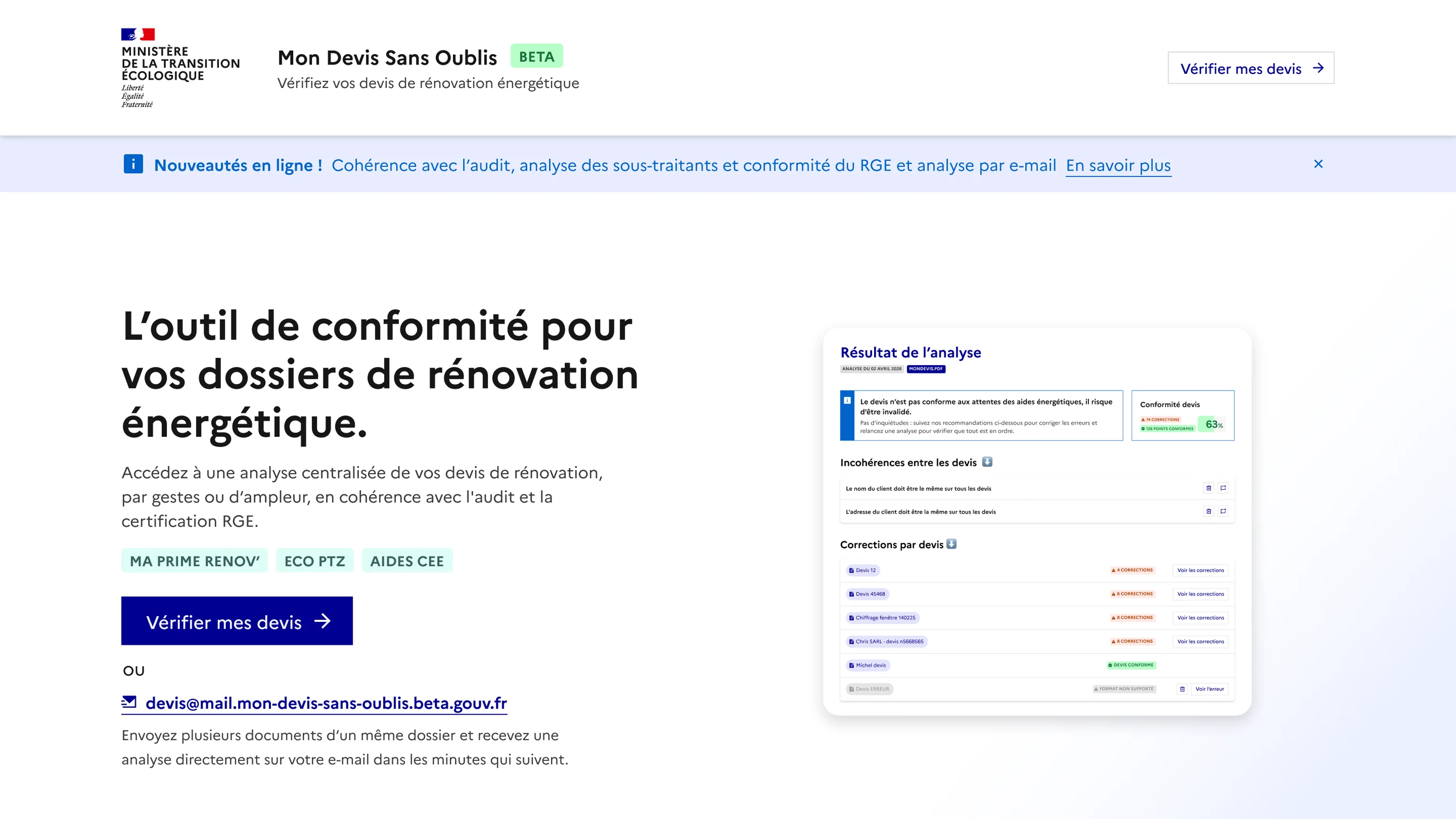
The home page: upload your quote and get a pre-check within minutes.
Housing accounts for 11% of greenhouse gas emissions in France. The government is aiming for 700,000 energy renovations a year, backed by financial aid such as MaPrimeRénov', energy savings certificates (CEE), the zero-interest eco-loan (éco-PTZ) and the reduced 5.5% VAT rate.
The problem: most quotes and invoices contain errors or missing information. The result: long, frustrating back-and-forth between homeowners, contractors and France Rénov' advisors, longer processing times, and households that end up giving up. On top of that, there was no standard reference for the information required for each type of renovation work.
Mon Devis Sans Oublis is a beta.gouv state startup, a winner of the FAST program, run by La Fabrique Numérique de l'Écologie.
The mission in numbers 📊
11,000+quotes analyzed since the V1 launch in January 2025
1,000quotes analyzed in a single week, at the May 2025 usage peak
3API partnerships live with industry tools, and around fifteen more in discussion
300+video calls with public and private players across the industry
Using AI to review quotes 🤖
The tool automatically pre-checks quotes using AI (Mistral, Albert), in three building blocks: reading the PDF to extract structured data, an algorithm that checks this data against regulations, and an interface that helps fix the quote.
That last building block, and the entire journey around it, is what I designed.
One journey, three audiences 👥
Contractors in the field, short on time. Homeowners with no expertise, often anxious about paperwork. Mon Accompagnateur Rénov' (MAR) renovation advisors, experts who need tracking and annotation tools. Three profiles with radically different needs, on the same journey.
So the journey stays as simple as possible: choose your profile and your type of renovation (single work item or comprehensive renovation), upload your quotes, and get the analysis results.
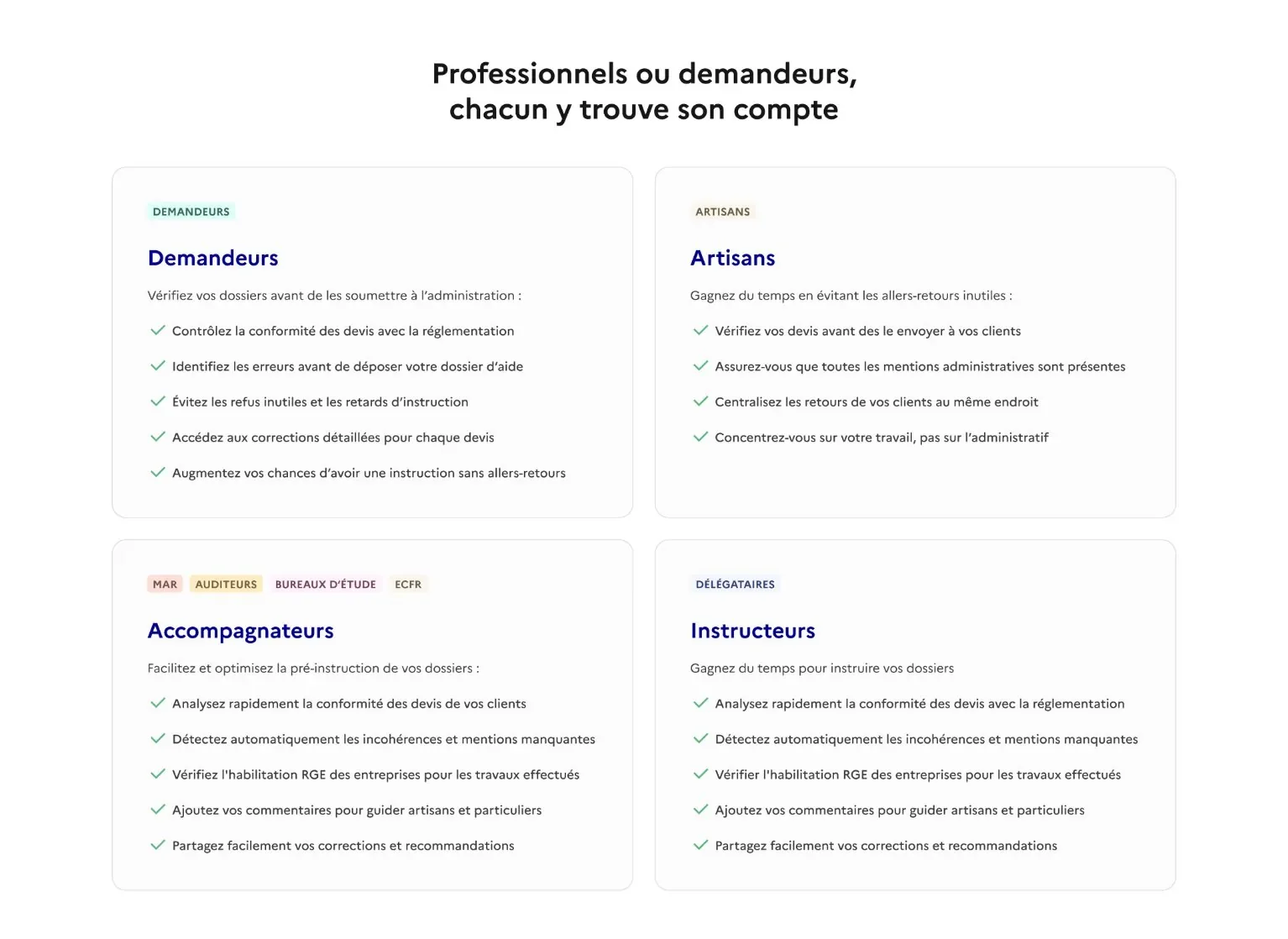
On the home page, each profile sees what the tool does for them: applicants, contractors, advisors and case officers.
Making highly technical results readable 🔍
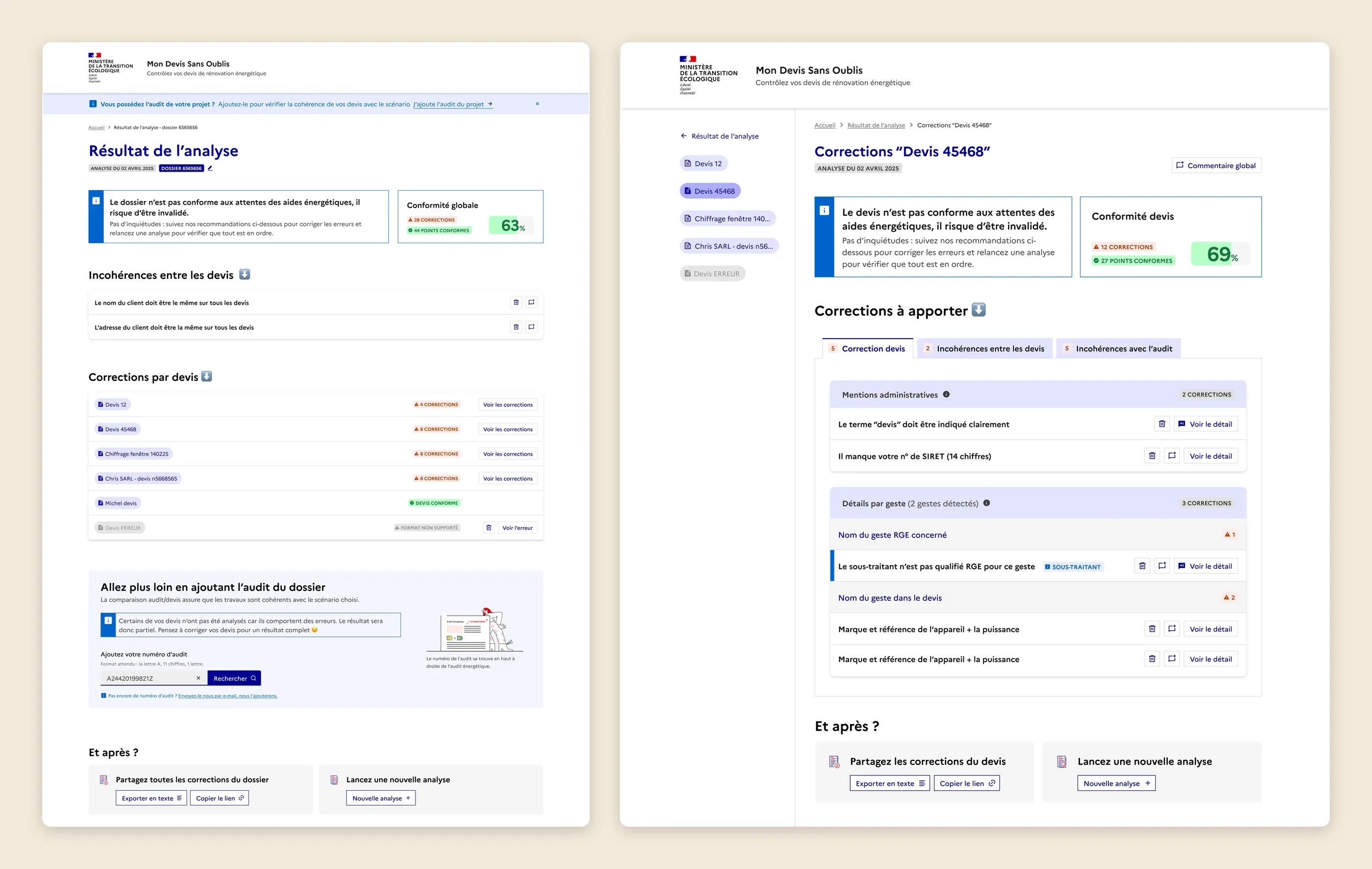
Results show a compliance rate, overall and per quote. Corrections are sorted into three categories: overall inconsistencies, missing or incorrect administrative information, and technical work descriptions.
For a comprehensive renovation involving several quotes, the tool also checks that they're consistent with one another: client name, address, etc.
MAR advisors, and only them, can comment on each quote and each correction line. Corrections can then be exported as text or shared via a link.
Left: the analysis results for a whole application, with overall compliance, inconsistencies between quotes and corrections per quote. Right: the detailed corrections for a single quote, sorted by category.
Clear results, without false certainty ⚖️
An automated analysis is never 100% reliable. On the interface side, the challenge was to present the results in a useful, understandable way, explaining what was detected without passing it off as absolute truth.
All of this in strict compliance with the DSFR, which I sometimes had to extend for use cases it didn't natively cover, while keeping technical information and ever-changing regulations accessible and clear.
Why the service shut down
Despite excellent user feedback, the product was suspended in May 2026, for structural reasons outside the product itself:
ANAH processing times (6 to 7 months) made the time saved on quotes almost invisible to users.
Integrating the tool into ANAH's information systems wasn't possible within the given timeframe.
MaPrimeRénov' was repeatedly suspended and reopened in 2025 and 2026, with no budget law in place, which broke the usage momentum.
The funding needed to finish the key features wasn't secured.
In a state startup, knowing when to stop is part of the method. The team published a full post-mortem, and the code is open source:
Designing a single journey for 3 personas with radically different needs
Presenting the results of an automated analysis clearly and with nuance, without false certainty
Applying the DSFR, and extending it when use cases weren't natively covered
Making complex data readable for non-experts: types of renovation work, regulatory requirements
Working within a small product team (developers, portfolio manager, deployment lead), following the state startup methodology: rapid iteration, impact measurement, and a deliberate shutdown
Wrapping up
A project that showed me from the inside how a state startup works, with the French State Design System and accessibility at the heart of every decision. And a shutdown that serves as a reminder that a good product, loved by its users, isn't always enough: it also depends on everything around it.
 FREN
FREN